The spare tire needs more air pressure than a normal tire because it is typically much smaller and narrower, requiring higher internal pressure (PSI) to safely support the vehicle’s weight and prevent damage during emergency use.
Many drivers overlook their spare tire until they desperately need it. But did you know this crucial backup often requires significantly higher air pressure than your everyday tires? This difference can be confusing: why does a tire that sits unused most of the time need extra air? Understanding this specific requirement is vital for your safety, maximizing the spare tire’s brief lifespan, and ensuring you are prepared for roadside emergencies. This article will explain in detail why spare tires are inflated to a higher PSI, how much air they should hold, and offer practical tips to maintain your spare so it’s always ready for action.
Table of Contents
What Is a Spare Tire and Why Is It Different?
The spare tire is fundamentally different from a regular tire because it is designed only as a temporary emergency backup.1
The Role of a Spare Tire
Your spare tire is an essential backup safety tool intended to be used only if one of your primary tires suffers a flat or damage.2 Its main role is to get you to safety, specifically to a location where you can repair or replace your damaged tire.3 It is not designed for regular driving, high speeds, or long trips.4 It is a short-term, temporary solution meant to help you drive slowly and carefully to the nearest service center or repair shop.
Types of Spare Tires
Understanding the type of spare tire you have is key, as it dictates the required air pressure:
-
Full-size Spare: This tire is the same size as your regular tires.5 Even if it matches in size, manufacturers usually intend it for temporary use unless specified otherwise.
-
Compact Spare (or “Donut”): This is the most common type of spare. It is notably smaller, narrower, and lighter than your primary tires. This compact design is the primary reason why it requires special air pressure.
Most compact spares require significantly more air pressure than regular tires (often 6$60$ to 7$80$ PSI).8 Because they are much smaller and thinner, they need this higher inflation level to create enough stiffness and load-bearing capacity to safely support the weight of the vehicle for the short time they are in use.
Why Does the Spare Tire Need More Air Pressure? (Concise)
The spare tire needs significantly higher air pressure (PSI) than a regular tire for three main reasons:
1. Supports Vehicle Weight on a Smaller Size
Compact spare tires are smaller and narrower than primary tires. To safely carry the full weight of the vehicle on a smaller surface, the air inside must be highly compressed. This high internal pressure makes the small tire firm and rigid enough to support the load without buckling.
2. Prevents Overheating and Blowouts
Under-inflation in any tire is dangerous, but especially in a spare. Low pressure causes the tire to flex excessively, which creates intense heat and friction. The higher required PSI prevents this overheating, minimizes wear, and significantly reduces the risk of a blowout during emergency use.
3. Maintains Readiness During Storage
Spare tires can sit unused for years. The high air pressure helps maintain the tire’s structural shape over time, preventing deformation, flat spots, or dry rot that can occur if the tire is stored while under-inflated. This ensures the spare is immediately usable when an emergency occurs.
How Much Air Should a Spare Tire Have?
For maximum safety and reliability during an emergency, your spare tire should have significantly more air pressure than your regular tires, typically ranging between 60 and 80 PSI (pounds per square inch) for most compact spares, which is nearly double the $30$ to $35$ PSI commonly used in standard tires. You must always check the recommended pressure for your specific spare, which can be found in three reliable places: the vehicle’s owner’s manual, on a sticker inside the driver’s door jamb, or printed directly on the sidewall of the spare tire itself. It is critical not to use the same low pressure as your normal tires; filling a small spare to only $30$ PSI would leave it too soft to safely support your vehicle’s weight, causing rapid wear, instability, and a high risk of tire failure when you need it most.
When Should You Check and Inflate Your Spare Tire?
You should check and inflate your spare tire’s pressure at least once a month, as part of your regular tire maintenance routine, and always before taking long trips or during significant seasonal changes (like the transition from summer heat to winter cold).
Regular Tire Maintenance Includes Your Spare
Many drivers forget about their spare tire. But checking your spare tire pressure should be part of your regular tire maintenance routine. Experts recommend checking it at least once a month.
Before Long Trips or Seasonal Changes
Always check the spare tire before taking long trips or during seasonal changes, especially in areas like Texas, where hot summers can increase tire pressure and cold winters can reduce it.
How to Check Spare Tire Pressure
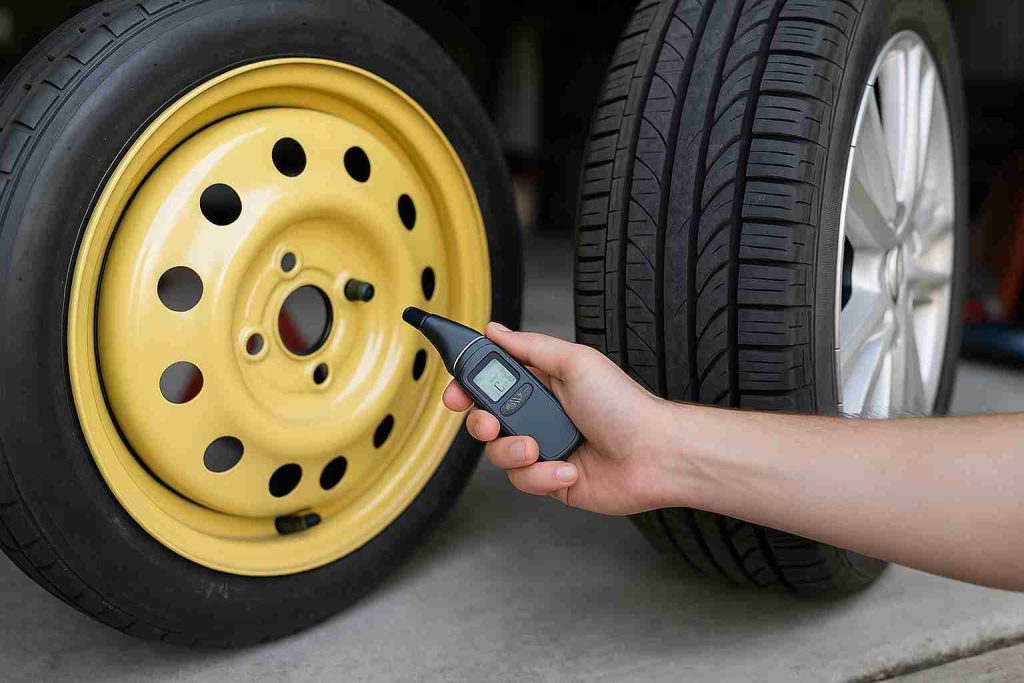
You can use a basic tire pressure gauge available at most auto stores or gas stations. Simply remove the valve cap from the spare tire, press the gauge on the valve, and read the pressure. If it’s below the recommended PSI, add air using an air compressor.
What Happens If Your Spare Tire Is Under-Inflated?
If your spare tire is under-inflated when you need it, you risk serious safety issues and major costs. Low air pressure immediately compromises safety and control, making your car unstable, difficult to steer, and increasing the risk of an accident. The biggest danger is the immediate damage: under-inflation causes the small tire to flex too much, generating intense overheating and friction that leads to dramatically faster wear and a high risk of catastrophic tire failure or a blowout. Ultimately, if this emergency tire fails, you will be left stranded, facing costly towing fees and significant delays for emergency roadside assistance.
What To Do When You Need to Use Your Spare Tire
When you have to use your spare tire, remember that it is a temporary emergency solution and requires immediate action and cautious driving. First, you must Drive Carefully and Slowly; most spare tires, particularly compact “donuts,” are rated for low speeds, so you should drive carefully, ideally below 50 mph, and avoid sudden braking or sharp turns. Second, your absolute priority must be to Replace or Repair the Damaged Tire ASAP; the spare is not built for long distances or regular driving, so seek professional service as quickly as possible. Finally, once you have finished using the spare and put it back into storage, Check the Spare Tire Pressure After Use to ensure it is re-inflated to the high PSI required, guaranteeing it will be ready for your next emergency.
Conclusion: Why Taking Care of Your Spare Tire Matters
Your spare tire is an essential, often-forgotten, safety tool designed specifically for emergencies. Its need for higher air pressure than your regular tires stems from its smaller size, allowing it to safely support your vehicle’s weight during a tough situation. Proper maintenance, including regular pressure checks and knowing how to use your spare correctly, is crucial for staying safe and prepared on the road. Taking a few minutes each month to care for your spare can save you from costly repairs, dangerous breakdowns, and unexpected delays. If your spare is hard to access, or if you need professional help ensuring all your tires, including the spare, are correctly inflated, Mr. DeSoto Mobile Mechanic offers immense value by coming to your location. This convenient service solves the problem of difficult maintenance, giving you peace of mind knowing your spare tire is maintained correctly and ready to perform whenever you need it most.
FAQs
This is for safety, a fact that Mr. DeSoto Mobile Mechanic confirms. A compact spare (“donut”) is much smaller and thinner than your regular tires. To safely hold up the weight of your car on a smaller surface, the air inside has to be squished more tightly. This high pressure, typically 60-80 PSI, keeps the small tire firm and prevents it from getting damaged or failing when you drive on it temporarily. Think of it like a smaller balloon needing more air to be just as firm as a big balloon.
You should check your spare tire pressure at least once a month. Tires naturally lose air over time, even when they aren’t being used, at a rate of about 1-3 PSI per month. It’s smart to check the spare every time you check your regular tires. If you can’t get to a shop or find your spare hard to reach (like if it’s stored under your vehicle), Mr. DeSoto Mobile Mechanic can come to you to check and adjust the pressure on all your tires, including the spare.
The correct pressure is always the manufacturer’s recommended PSI. This is usually listed on a sticker inside the driver’s door jamb, in your vehicle’s owner’s manual, or sometimes printed directly on the spare tire’s sidewall. For most compact spares, the pressure is very high typically between 60 and 80 PSI. Using the wrong pressure can be dangerous, so always check the specific number for your vehicle.
No, absolutely not. Spare tires, especially the compact “donut” type, are meant for temporary, emergency use only. They are engineered with a shallower tread and weaker structure designed only to get you safely to the nearest repair shop or home. You must limit your speed (usually below 50 mph) and drive for no more than 50-70 miles before getting a proper replacement or repair.
If your spare is low on air, it can be very dangerous. Under-inflation causes the tire’s sidewalls to flex too much (which is called deflection). This generates excess friction and heat, leading to rapid wear, risk of tire failure (a blowout), and poor vehicle control. Mr. DeSoto Mobile Mechanic can inspect your spare to ensure it’s safe and correctly inflated before an emergency hits, potentially saving you from a roadside breakdown.
Temperature directly impacts tire pressure because air expands when it’s hot and contracts when it’s cold. For every $10^\circ \text{F}$ change in air temperature, your tire pressure will change by about 1 PSI. In cold weather, pressure goes down, making the tire soft. In hot weather, pressure goes up. Regular checks, especially when the seasons change, are critical for maintaining the right PSI.
The most accurate place to find the recommended PSI is usually on the placard (sticker) located on the inside of the driver’s side door frame or door jamb. If it’s not there, check the car’s owner’s manual under the “Tires” section. For compact spares, the recommended pressure is often also stamped right onto the sidewall of the tire itself.
It needs more air because it has to safely carry the same weight as your larger regular tire while using a much smaller volume of air and a narrower patch of rubber touching the road (the contact patch). The higher internal pressure is necessary to distribute the car’s load evenly and prevent the tire from becoming too soft, which could lead to overheating and damage.
For a compact spare (“donut”), no, you should never rotate it into regular use because it has a significantly different size and construction. For a full-size spare that is an exact match and on a matching rim, some experts suggest rotating it to ensure all five tires wear evenly and age at the same rate. If you’re unsure which type of spare you have and what maintenance it needs, Mr. DeSoto Mobile Mechanic can inspect it for you.
You will need a simple tire pressure gauge (digital or stick-type). First, locate the valve stem on your spare and unscrew the valve cap. Then, press the gauge firmly onto the valve stem and read the number. If it’s too low, you must add air using an air compressor until it reaches the manufacturer’s high-PSI recommendation. Mr. DeSoto Mobile Mechanic offers convenient mobile service to help you check and inflate even hard-to-reach spares correctly.